


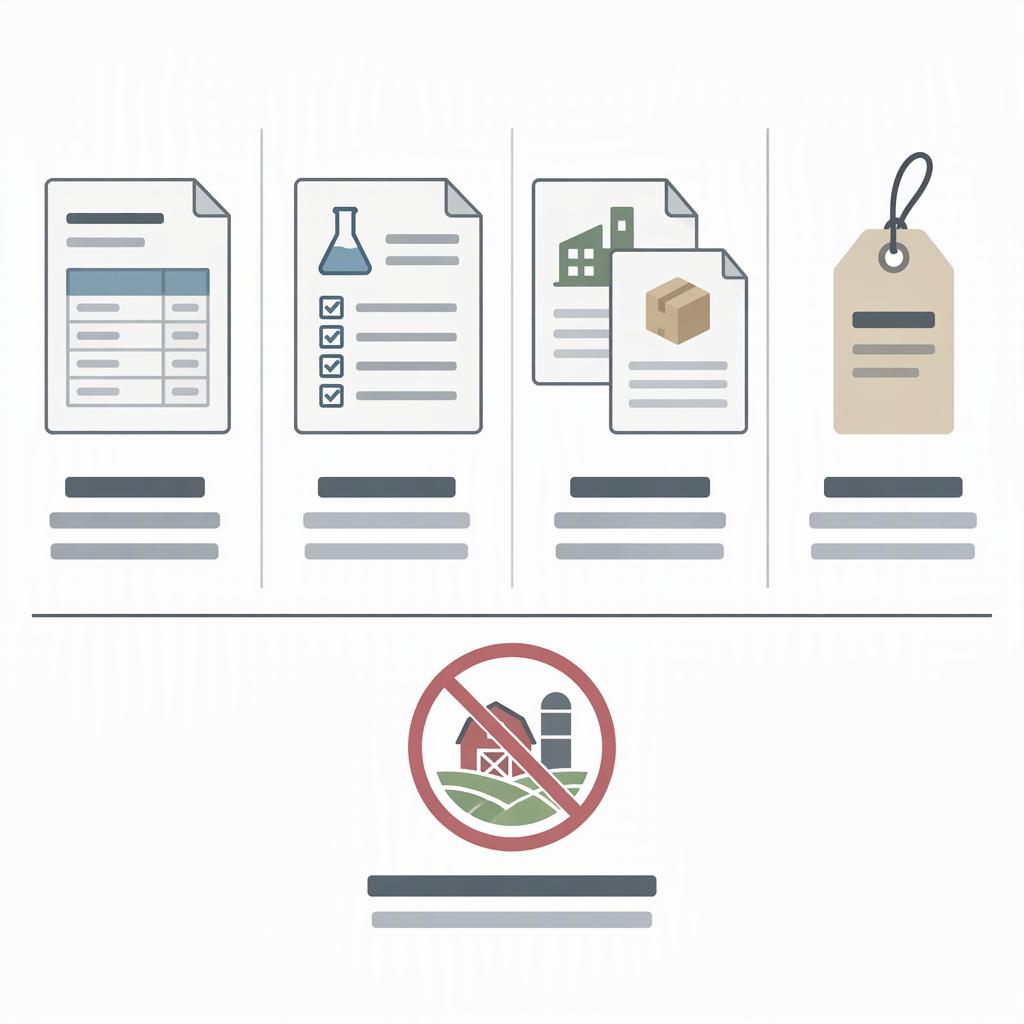
Tracing cashmere yarn back through the supply chain means matching each document to the question it answers: a fibre test report and the invoice cover what the yarn contains and where it was traded; a scope certificate with a per-shipment transaction certificate covers who handled certified material; a cashmere-specific standard certificate covers how the fibre was produced; and the label covers how the garment may be described. None identifies the individual farm behind a finished sweater.

What documents trace cashmere yarn back through the supply chain?
A documented cashmere chain normally carries five document groups: fibre and yarn test reports, commercial documents such as invoices, chain-of-custody scope and transaction certificates, cashmere-specific farm and processing-site certificates, and the finished product label. Each group comes from a different party at a different stage, and each covers only that stage.
- Fibre and yarn stage — spinner or dehaired-fibre supplier: ask for a fibre-content test report from a qualified independent laboratory. Routine independent testing is advised because an invoice statement of cashmere content cannot necessarily be relied on by itself.
- Commercial stage — the seller in each transaction: invoices and similar papers record what moved between two named parties, on what date and in what quantity, and under the US Textile and Wool Rules these documents may be issued electronically and preserved in non-paper form.
- Certification stage — the certification body: a scope certificate is awarded per site after an audit, and a transaction certificate is issued for each shipment of certified product.
- Farm and processing stage — the standard owner's independent auditors: for The Good Cashmere Standard, audits cover cashmere farms, buying stations and dehairing stations, and the producer's certificate is valid for 12 months.
- Product stage — the brand or manufacturer placing the garment on the market: the label must state fibre content percentages, country of origin and the responsible business name or registered identification number for US sale.
A complete document set is not the same thing as traced fibre. It cannot connect your yarn lot to a farm or herd, and a supplier's own declaration is not independent verification.
Which question does each document actually answer?
Each document answers one question and leaves the others open. A test report answers what the tested fibre is; an invoice answers what was traded, by whom and when; a scope certificate answers whether a named site is certified; a transaction certificate answers whether certified material moved on a specific shipment; a label answers how the item must be described to buyers. None of them answers all five.
| Document | Issued by | Question it answers | What it leaves open |
|---|---|---|---|
| Fibre-content test report | Independent laboratory, commissioned by supplier or buyer | Whether the tested sample matches the cashmere definition and the declared content | Whether later production matches the tested lot |
| Invoice or other commercial document | Seller in each transaction | What material, quantity and value moved between two named parties on a date | Whether the material is genuinely cashmere or certified |
| Scope certificate | Certification body, per site | That the named site is certified for a stated scope after an on-site audit | That a particular shipment came from that site |
| Transaction certificate | Certification body, per shipment | That certified material was transferred from the stated producer to the stated recipient | Fibre fineness, geographic origin or product performance |
| Product label | Brand or manufacturer placing the product on the market | The content, origin and responsible-business disclosure required for sale | Where the fibre came from or how the yarn was handled |
United States federal guidance sets the definition itself: fibre may be described as cashmere only if it is the fine dehaired undercoat of the Cashmere goat, averages no more than 19 microns, contains no more than 3% by weight of fibres above 30 microns, and its coefficient of variation around the mean does not exceed 24%. The same guidance advises routine testing by a qualified independent laboratory. Before treating a "100% cashmere" description as settled, read the FTC guidance on the Wool Products Labeling Act.
What do fibre test reports and labels prove about cashmere content?
A fibre test report tells you how a tested sample measured against the cashmere definition and the declared blend. A product label tells you what the seller must disclose. Neither says where the fibre came from, and a report describes only the sample that was tested.
Do not read a label as origin evidence. The disclosure duties cover fibre content, the country of origin determined under customs rules and the responsible business, not the farm or the herd.
For apparel sold in the United States, care instructions are also required, and a "Dry Clean Only" instruction has to be supported by evidence that washing would harm the garment — so a care claim that contradicts your own wash trials is a prompt to question the rest of the label pack.
Textile and Wool Rules guidance confirms that the definitions of "invoice" and "invoice or other paper" were amended so those documents can be issued electronically and records preserved in forms other than paper, and it also explains hang-tag disclosure conditions and country-of-origin determination under customs rules. See the FTC guidance on labelling requirements under the Textile and Wool Acts.
How do scope certificates and transaction certificates trace a yarn shipment?
A scope certificate covers one site and its defined scope; a transaction certificate covers one shipment. Together they show certified material moved between audited parties — not that your carton's yarn came from a farm.
- Check the site: the scope certificate should name the spinning, knitting or trading site that actually handles your order, not only a parent company or another factory.
- Check the validity dates against your production and shipping window, not against the day the PDF arrived.
- Check the scope: the certificate must cover the material and the processing stage in your order, not a different product category.
- Check the shipment: ask for the transaction certificate issued for your shipment as well as the site's scope certificate.
- Check the volumes: chain-of-custody systems require documented receiving, processing and transfer, volume reconciliation and controls for material segregation, so quantities in and out of each site should reconcile with your order.
- Record the certificate number, the issuing body and the date you verified it, so the file can be re-checked when the certificate expires or the supplier changes site.
A chain-of-custody certificate does not certify fibre fineness, geographic origin or product performance. Read it as evidence about who handled certified material, not as evidence that the fibre is finer, warmer or better than another supplier's.
The trail records transfers of certified material rather than an individual tracer on your garment's fibre, and tracers are not accepted as equivalents. See Textile Exchange's explanation of chain of custody, scope certificates and transaction certificates.
Which standards actually cover cashmere, and what do they certify?
Cashmere-specific coverage is narrow. The Good Cashmere Standard audits cashmere farms, buying stations and dehairing stations and issues a producer certificate valid for 12 months, with an initial regional focus on Inner Mongolia. The Responsible Wool Standard covers sheep wool, and the first edition of the Materials Matter Standard lists wool, alpaca, mohair and recycled materials — cashmere is not among them.
The Good Cashmere Standard is a voluntary standard owned by the Aid by Trade Foundation; its independent audits verify whether cashmere farms and production sites, specifically buying stations and dehairing stations, meet its criteria. A certificate shows that those sites passed an audit against those criteria; it does not describe the yarn specification or the finished garment.
A wool certificate is not cashmere evidence. The Responsible Wool Standard requires all sites from wool farms through to the seller in the final business-to-business transaction to be certified, which makes it a strong credential for wool programmes and irrelevant to a cashmere fibre claim.
Check transition dates as well as names: the first edition of the Materials Matter Standard becomes effective on 31 December 2026 and mandatory on 31 December 2027, with claims and labels moving to the new standard by 30 June 2029, while the Content Claim Standard continues to support chain of custody and product claims. A standard that is not yet in force does not certify anything today.
How should a buyer verify supplier documents before accepting them?
Verify at the issuer, not at the PDF. Check that the certificate appears in the issuing body's own system, and that the named site, scope and validity dates match your order. File the verification note with the order.
- Look the certificate up in the scheme's own platform or certified-company directory instead of relying on a scanned copy: certificate and transaction data are held centrally, and public modules exist for finding a certified company and authenticating a transaction.
- Match the legal name and site address on the certificate to the entity you are contracting with and to the site that will run your order.
- Confirm the scope covers your product category and processing stage, since a certificate is issued for a defined scope rather than for everything a supplier sells.
- Confirm the validity window still covers your production dates, and re-verify with the issuing body if the copy is older than that window.
- For each shipment, check that the transaction certificate names the correct producer and recipient and matches your shipping documents.
- Keep a one-page verification record per supplier: certificate number, issuing body, scope, validity dates, verification date and next re-check date.
What can documentation not prove about cashmere yarn?
Documents cannot identify the individual farm or herd behind a finished garment, cannot prove fibre fineness beyond what a specific tested sample shows, and cannot prove conditions at a site that was never audited. Textile Exchange states that its standards are not designed to provide full supply chain transparency, so a party seeking to identify every site has to work with suppliers and ask them to disclose their sources.
Even inside a certified chain, the trail follows transfers of certified material, not an individual tracer on your fibre.
Textile Exchange's chain-of-custody explanation sets out exactly what that trail covers.
What should a cashmere buyer request before placing an order?
Send one request that covers six items: a fibre-content test report, scope certificates for the exact sites in the chain, a transaction certificate for each shipment, any cashmere-specific standard certificate with its audit scope and validity, the label artwork with content, origin and responsible-business details, and the commercial documents for each transaction.
- Fibre-content test report from a qualified independent laboratory, with the sampling plan behind it.
- Invoice or equivalent commercial document stating material, quantity, date and both parties.
- Scope certificate for the spinner and for the knitter, naming the specific sites and the scope that covers your product.
- Transaction certificate for each shipment, matched to the shipping documents.
- Cashmere-specific standard certificate where the claim depends on one, with its audit scope and 12-month validity period.
- Label artwork showing fibre content percentages, country of origin and the responsible business name or registered identification number.
| Situation | What it means for your order | What to do next |
|---|---|---|
| No fibre-content test report | The content claim would rest on the supplier's own statement | Commission independent testing before the content claim goes on a label |
| Scope certificate names another site or scope | The certificate does not describe the party making your order | Request the certificate for that site and scope, or record in writing that the chain is uncertified |
| No transaction certificate for the shipment | The transfer of certified material between the named producer and recipient is not documented | Match the shipment record to the certificate before the claim is used in marketing |
| Certificate issued under a different fibre standard | A wool or recycled-material certificate cannot evidence a cashmere fibre claim | Keep it as a general supplier credential and request cashmere-specific documentation alongside |
Know who carries the duty. Directive (EU) 2024/1760 entered into force on 25 July 2024 and has since been amended; it requires very large companies meeting stated employee and turnover thresholds to identify and address adverse human rights and environmental impacts in their own operations, subsidiaries and chains of activities. Micro companies and SMEs are not covered, national transposition measures are due by 26 July 2028, and application starts on 26 July 2029. If those thresholds apply to you, the documents you collect from a yarn or knitwear supplier become your own due-diligence evidence; confirm the current position on the European Commission's corporate sustainability due diligence page.
How should a buyer use these documents in practice?
Use the set to match claims to evidence, layer by layer: content evidence for what the fibre is, commercial records for what moved, custody certificates for who handled certified material, and production-site certificates for where it came from. Ask for the layers that support the claim you intend to make, verify each document at its issuer, and decide in advance which claims you will drop if a document does not arrive.
A short written position per order keeps the decision honest: state the claim you will make, list the documents that support it, note what you could not obtain, and record what you will not claim as a result. Re-check that position whenever the supplier, the site, the standard edition or the shipment changes — on documentation questions, a lapsed certificate and a missing certificate carry the same weight.
Frequently asked questions
Six follow-up questions decide most cashmere documentation arguments; each is answered below.
What is the difference between a scope certificate and a transaction certificate?
A scope certificate is awarded to one site after an on-site audit and covers a defined scope of products and processes; it tells you whether that site may handle certified material. A transaction certificate is issued to the producer and the recipient for each shipment and tells you certified material moved.
Do yarn count, gauge and ply specifications count as traceability documents?
No. Count, gauge and ply describe how a yarn or knit is constructed and behaves in production, so they are engineering specifications rather than records of custody or content. They cannot substitute for a fibre-content test report or a chain-of-custody certificate.
Are electronic invoices and digital records acceptable as traceability evidence?
Yes. US Textile and Wool Rules guidance states that the definitions of "invoice" and "invoice or other paper" were amended to allow those documents to be issued electronically and to allow records to be preserved in forms other than paper. The same limits still apply: an electronic invoice remains a commercial record of what moved between two parties, not proof of fibre content.
What can a buyer do when a small spinner or knitter holds no chain-of-custody certificate?
Treat the gap as a claim boundary rather than an argument to be won. Commission fibre-content testing from a qualified independent laboratory for the content claims you want to make, keep the commercial documents complete, and restrict marketing to what those documents support.
Does a farm-level cashmere certificate cover the finished knitted garment?
Not on its own. The Good Cashmere Standard audits cashmere farms, buying stations and dehairing stations and issues a producer certificate valid for 12 months, so it speaks about production and processing sites rather than about your finished knitwear. A garment-level claim also needs the chain-of-custody documentation covering the later stages, including a transaction certificate for the shipment.
Does a certificate issued to one site cover yarn made at another site?
No. Scope certificates are awarded per site after an on-site audit and document review, so a certificate issued to one spinning or knitting site does not cover a different facility, even when both belong to the same group. Confirm each site holds its own current certificate for your material and process.


