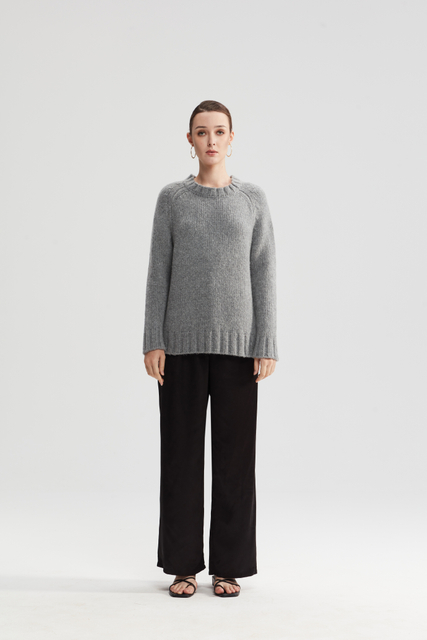
MOQ is the number that stops more knitwear brand conversations than any other.
A founder has a clear vision, a strong brand concept, and a manufacturer they are genuinely excited about. Then the MOQ comes up — and the conversation either moves forward or quietly dies.
This guide is for the brands who want to understand what MOQ actually means in cashmere knitwear manufacturing, why the numbers are what they are, and how to structure a sourcing conversation that works for both sides.
First: What MOQ Actually Is (and What It Is Not)
MOQ — Minimum Order Quantity — is not an arbitrary number a factory invented to exclude small brands. It is a reflection of the economics of production.
Every production run has fixed costs that do not scale with volume: machine setup, yarn dyeing minimums, quality control labor, finishing and pressing, documentation and packing. When a factory sets a minimum order, they are setting the threshold at which those fixed costs are distributed across enough units to make the run economically viable.
Understanding this is important because it changes the conversation. MOQ is not a wall — it is a variable with real drivers behind it. And those drivers are different depending on the product.
Why Cashmere MOQ Is Different From Other Knitwear
Cashmere knitwear has higher MOQs than cotton or acrylic knitwear for reasons that are specific to the fiber and the production process.
Yarn Dyeing Minimums
Cashmere yarn is dyed in batches. Most professional yarn dyehouses have a minimum dyeing weight — typically 10–15kg per colorway. For a fine-gauge cashmere yarn (e.g., 2/28Nm used in 16GG and 18GG knitting), 10kg of yarn translates to roughly 80–120 finished garments depending on the style weight.
This means that even before a single stitch is knitted, the colorway minimum is already setting a floor on your order size.
Machine Setup and Gauge Specificity
Different gauges require different machines. A 16GG or 18GG fine-gauge machine is a precision instrument — the needles are spaced at 16 or 18 per inch, capable of producing fabric with a hand-feel and drape that coarser gauges simply cannot replicate. Setting up a 16GG or 18GG machine for a production run involves calibration time, test knitting, and adjustment that is not trivial.
This is why fine-gauge orders — particularly in 16GG and 18GG — tend to carry slightly higher MOQs per style than mid-gauge (7GG–12GG) production. The setup cost is real, and it needs to be amortized across enough units.
Specialty Fiber Blends
Blended yarns — particularly cashmere/silk velvet, cashmere/fine wool, and cashmere/Tencel — are often custom-spun or sourced in smaller batch quantities. The supply chain for a 16GG cashmere/silk velvet blend is more complex than for a standard 2-ply cashmere yarn, and the minimum viable batch for custom spinning is typically larger than for commodity yarns.
This is not a reason to avoid specialty blends — it is a reason to plan for them correctly.
The MOQ Framework: How to Think About It by Product Type
Not all cashmere products have the same MOQ. Here is a practical framework:
Standard MOQ Ranges by Gauge and Fiber
Product Type
Gauge
Typical MOQ per Style/Color
Notes
Chunky / Oversized Knit
3GG – 5GG
100–150 pcs
Lower yarn cost per piece; faster knitting
Mid-gauge Classic
7GG – 12GG
150–200 pcs
The most common cashmere knitwear category
Fine-gauge Luxury
14GG – 15GG
200–250 pcs
Longer knitting time; higher yarn precision
Ultra Fine-gauge
16GG – 18GG
200–300 pcs
Premium setup; specialty machine requirement
Cashmere / Silk Velvet Blend
16GG – 18GG
250–300 pcs
Custom yarn sourcing; dyeing complexity
Cashmere / Fine Merino Blend
14GG – 18GG
200–300 pcs
Precision spinning required
Organic Cashmere (GOTS)
Any gauge
+20–30% vs. standard
Segregated production line requirement
Note: These are indicative ranges. Actual MOQ depends on style complexity, colorway count, and the specific development brief. A simpler silhouette in a single colorway will often qualify for the lower end of the range; a complex construction with multiple colorways will not.
The 16GG and 18GG Question: Why Fine Gauge Commands Attention
Fine-gauge knitwear — particularly 16GG and 18GG — represents the upper tier of machine-knitted luxury. Understanding why helps brands make better sourcing decisions.
What 16GG and 18GG Actually Delivers
At 16 or 18 needles per inch, the resulting fabric has a textile-like quality that bridges the gap between knitwear and woven fabric. The hand-feel is smooth rather than textured. The drape is fluid. The silhouette is clean and tailored rather than relaxed.
For brands building in the contemporary luxury or premium contemporary space — where the customer expects knitwear that works in a professional or elevated social context — 16GG and 18GG is often the right answer.
What it looks like in practice:
A 16GG cashmere/silk velvet blend turtleneck that reads as a luxury top, not a casual sweater
An 18GG pure cashmere fitted cardigan with the drape of a woven jacket
A 16GG cashmere/fine Merino blend trouser that holds its shape across a full day of wear
The Velvet Blend Advantage at Fine Gauge
Cashmere/silk velvet blends at 16GG–18GG are one of the most distinctive product categories in premium knitwear — and one of the least understood by brands who have not worked with them before.
The silk velvet component (typically 10–20% of the blend) does several things simultaneously:
Adds luminosity — a subtle sheen that catches light without looking synthetic
Improves drape — silk's natural weight and fluidity changes how the fabric falls
Enhances softness — the combination of cashmere fiber and silk creates a surface hand-feel that neither fiber achieves alone
Increases durability — silk strengthens the yarn structure, reducing pilling in fine-gauge constructions where cashmere alone can be vulnerable
The result is a fabric that photographs exceptionally well, wears luxuriously, and justifies a retail price point that pure cashmere at the same gauge cannot always command.
WFS operates dedicated 16GG and 18GG production lines with capacity specifically allocated for fine-gauge and velvet-blend programs. This is not a capability we offer occasionally — it is a core production focus.
How to Structure Your First Order Around MOQ Reality
The brands that navigate MOQ most successfully are the ones who plan their first season around MOQ reality rather than against it.
Strategy 1: Depth Over Breadth
Instead of developing 8 styles at 100 pieces each, develop 4 styles at 200 pieces each. The same total investment, but each style meets MOQ cleanly, gets proper production attention, and gives you enough inventory to test the market and reorder what works.
The reorder advantage: A style that sells through at 200 pieces is a style you can reorder at 200 pieces. A style that sells through at 100 pieces (below MOQ) is a style you cannot reorder without committing to a larger quantity than your sales data justifies.
Strategy 2: Colorway Consolidation
Every additional colorway in a style adds a yarn dyeing minimum. A 4-style collection in 3 colorways each requires 12 separate dyeing runs. The same collection in 2 colorways requires 8.
The practical approach: Launch in 2 colorways. Identify which colorway performs. Add the third colorway in your reorder or second season — when you have data to support the investment.
Strategy 3: Anchor Styles and Development Styles
Not every style in your collection needs to be a new development. Anchor styles — core silhouettes in your signature fiber and gauge — can be reordered from existing constructions with only colorway changes, which significantly reduces the effective MOQ. Development styles — new silhouettes, new blends, new constructions — carry the full development MOQ.
A well-structured first season might be: 2 anchor styles (reorders of proven constructions) + 2 development styles (new silhouettes). This balances risk and newness.
Strategy 4: The Fine-Gauge Investment Mindset
16GG and 18GG programs require a different investment mindset than mid-gauge programs. The per-unit cost is higher. The MOQ is higher. The development timeline is longer. But the product that comes out the other side commands a retail price that mid-gauge cannot.
A brand that commits to a 16GG cashmere/silk velvet program at 250 pieces per style is not making a larger bet than a brand doing 150 pieces of 7GG — they are making a different bet, at a different price point, with a different margin structure.
The math often works in fine gauge's favor. It requires the conviction to run it.
MOQ and Private Label: What Changes
For brands developing private label programs — where the manufacturer is developing styles, constructions, and sometimes yarns specifically for the brand — the MOQ conversation has an additional layer.
Development investment: Private label development involves design time, sampling, and often custom yarn development. This investment is typically reflected in either a development fee (credited against production) or a slightly higher MOQ on the first run.
Exclusivity: If a brand wants exclusivity on a construction or yarn blend — meaning the manufacturer will not sell the same fabric or style to other brands — this typically requires a higher MOQ commitment or a minimum annual volume agreement.
The long-term structure: The most successful private label relationships are built around a rolling annual volume commitment rather than order-by-order negotiation. A brand that commits to 2,000 pieces across a season gets better pricing, priority scheduling, and more development support than one placing 200-piece orders with no forward visibility.
What to Ask Your Manufacturer About MOQ
When you are evaluating a cashmere manufacturer, these are the MOQ questions that matter:
Question
Why It Matters
Is the MOQ per style or per colorway?
A 200-piece MOQ per colorway is very different from 200 pieces total across all colorways
Does the MOQ apply to reorders?
Some manufacturers reset MOQ on every order; others have lower reorder minimums
What is the MOQ for 16GG / 18GG specifically?
Fine-gauge minimums are often different from the headline MOQ
Is there a below-MOQ option, and what does it cost?
Some manufacturers will do smaller runs at a per-unit premium
How does MOQ change for GOTS-certified organic production?
Segregated organic production lines typically carry higher minimums
What is the minimum for a new colorway on an existing construction?
Colorway additions to existing styles often have lower minimums than new style development
WFS Cashmere MOQ Structure: What We Offer
We believe in transparency on MOQ because brands that understand our structure make better decisions — and better decisions lead to better partnerships.
Our standard MOQ framework:
Mid-gauge (7GG–12GG), standard cashmere: 150–200 pcs per style/colorway
Fine-gauge (14GG–15GG): 200–250 pcs per style/colorway
Ultra fine-gauge (16GG–18GG): 200–300 pcs per style/colorway
16GG–18GG cashmere/silk velvet blend: 250–300 pcs per style/colorway
GOTS-certified organic cashmere: Standard MOQ + 20–30%
Reorders on existing constructions: Often 20–30% below initial MOQ
What we offer brands at early stage:
Development samples before production commitment
MOQ flexibility for first-season programs with clear scaling plans
Dedicated development consultation to structure your collection around MOQ reality
We are not the right manufacturer for a brand placing 50 pieces per style. We are the right manufacturer for a brand that is serious about building a knitwear program — and wants a manufacturing partner who will invest in that program alongside them.
MOQ is not the obstacle it appears to be when you understand what drives it.
The brands that build successful cashmere knitwear programs are the ones who plan around MOQ reality from the start — who structure their collections for depth rather than breadth, who consolidate colorways strategically, and who choose their gauge and fiber blend based on the retail price point and margin structure they are building toward.
16GG and 18GG fine-gauge programs, particularly in cashmere/silk velvet and cashmere/fine Merino blends, are not for every brand at every stage. But for the brands that are ready for them — who understand the investment and the return — they represent one of the clearest paths to a defensible, premium product position in a crowded knitwear market.

 日本語
日本語 Français
 Русский
 Deutsch
 italiano
 简体中文
简体中文 English
 العربية
 Español
 Português
 한국어
한국어 Nederlands
 Tiếng Việt
 ไทย
ไทย Polski
 Türkçe
 አማርኛ
አማርኛ ພາສາລາວ
 ភាសាខ្មែរ
 Bahasa Melayu
 ဗမာစာ
ဗမာစာ தமிழ்
தமிழ் Filipino
 Bahasa Indonesia
 magyar
 Română
 Čeština
 Монгол
 қазақ
қазақ Српски
 हिन्दी
 فارسی
فارسی Kiswahili
 Slovenčina
 Slovenščina
 Norsk
Norsk Svenska
 українська
 Ελληνικά
 Suomi
Suomi Հայերեն
 עברית
עברית Latine
 Dansk
Dansk اردو
اردو Shqip
Shqip বাংলা
বাংলা Hrvatski
 Afrikaans
 Gaeilge
 Eesti keel
 Māori
Māori