


Cashmere garment finishing should be approved as a measured sequence, not as three isolated steps: washing can relax and move the knitted structure, blocking or shaping brings the garment back toward the approved specification, and pressing or steaming refines presentation while still affecting final measurements.
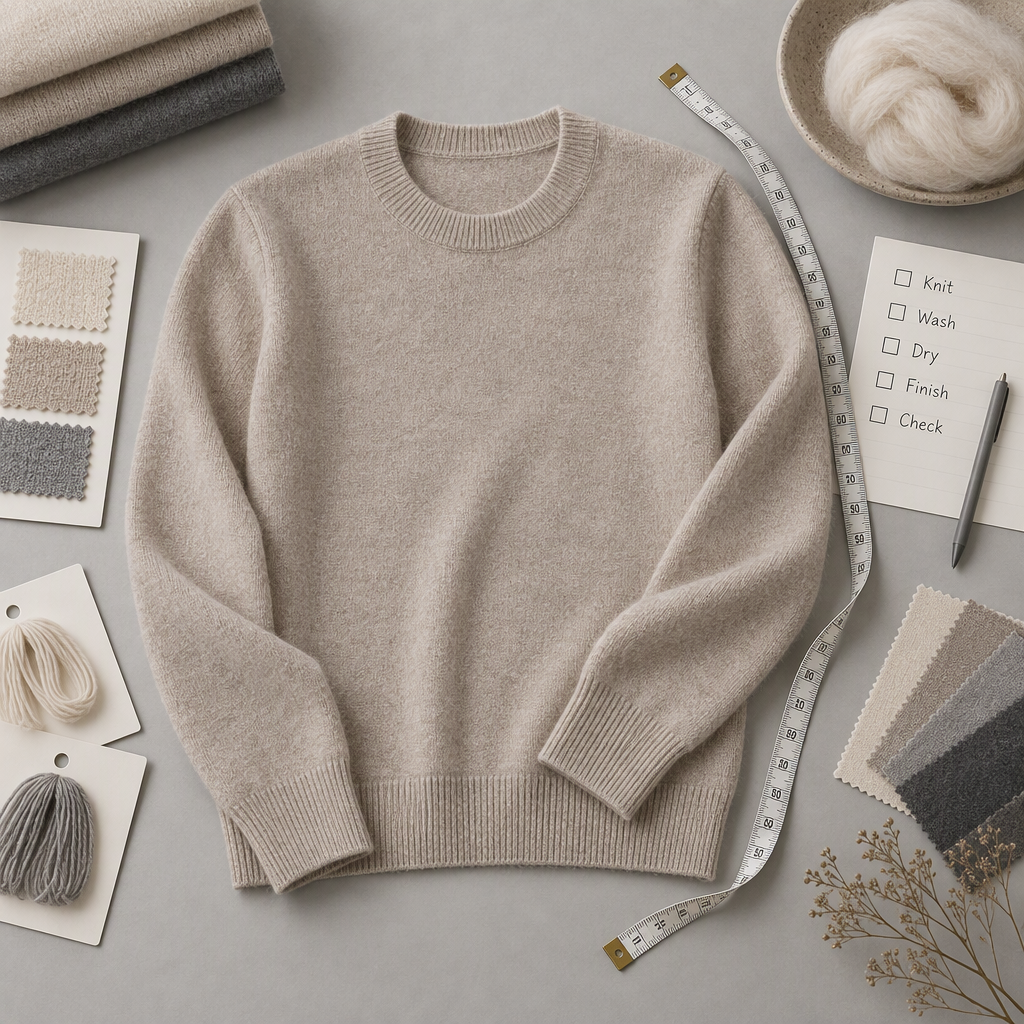
How washing affects cashmere garment dimensions
Washing is a dimensional risk point because it is part of the finishing process that influences softness, drape, appearance and final measurement outcomes.
- Treat wet finishing as a controlled operation, because wool knitwear finishing includes wet finishing, processing parameters, common faults and quality control.
- Measure the garment after finishing stages that affect final dimensions, not only after knitting.
- Compare the washed sample with the approved measurement chart before approving bulk production.
- Record the sample condition, measurement points and acceptance notes so later batches can be compared on the same basis.
Do not assume that a softer hand automatically means a stable size. Ask the supplier how the sample was washed, how it was dried or relaxed, and when measurements were taken. If a powered washer, dryer, steamer or press must be accessed for cleaning or clearing, switch it off and disconnect the applicable power source before any manual access, then follow the model manual's permitted access only.
Why blocking or shaping matters after washing
Blocking or shaping matters because washing may leave a cashmere garment relaxed or distorted, while shaping is used in finishing to help align the garment with intended dimensions and appearance.
| Buyer question | What to confirm | Why it matters |
|---|---|---|
| Which dimensions are critical? | Chest, body length, sleeve length, shoulder, hem and any style-specific points. | Measurement management is part of the described premium cashmere knitwear process. |
| When is the garment measured? | After washing and shaping, and again after final finishing if required. | Timing affects whether the sample reflects the condition that will be packed and shipped. |
| How is shaping controlled? | Ask whether the supplier uses size forms, templates, measurement charts or another documented control method. | Approval is clearer when the target shape is repeatable rather than judged only by appearance. |
- Mark critical measurement points on the tech pack.
- Require before-and-after sample measurements when size movement is a known concern.
- Approve the hand feel and the measurement chart together, not in separate decisions.
How pressing and steaming affect final presentation and measurements
Pressing and steaming can improve presentation, smoothness and drape, but they should be treated as finishing operations that can still influence the garment's final measured state.
| Finishing action | Buyer value | Measurement caution |
|---|---|---|
| Steam pressing | Helps refine the look of wool knitwear during finishing. | Confirm whether final measurements are taken before or after pressing. |
| Final pressing | Supports garment presentation before quality control and packing. | Do not use presentation alone as proof of dimensional stability. |
| Re-pressing a sample | Can make a review sample look cleaner. | Ask whether the bulk process will match the approved sample process. |
For buyer approval, pressing should not hide unresolved size movement. Ask for the final measurement condition in writing, especially when a garment looks correct on a hanger but the flat measurements are close to the tolerance limit.
How to view washing, blocking and pressing as one finishing sequence
A practical approval flow is to evaluate washing, shaping and pressing as connected finishing operations, because wool knitwear finishing covers wet finishing, garment finishing methods, steam pressing, common faults and quality control.
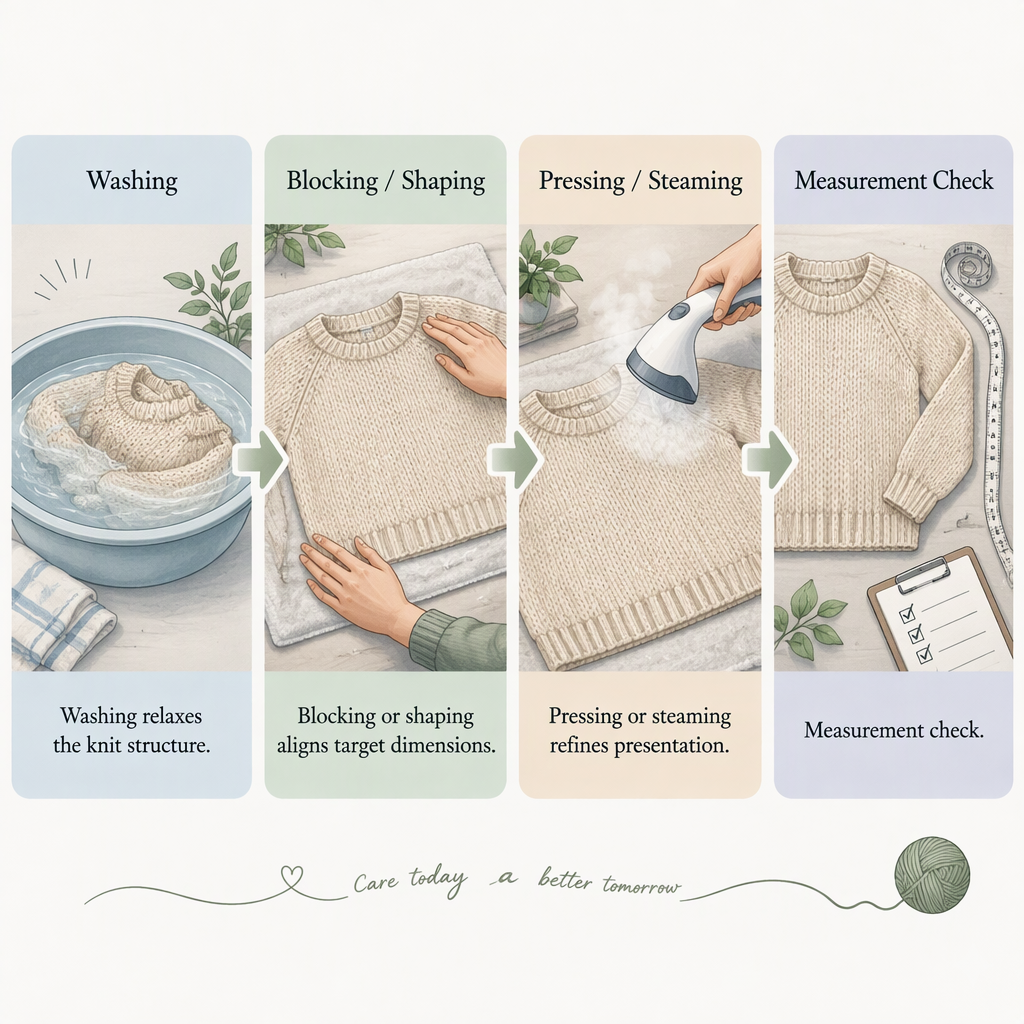
| Stage | Main decision | Approval evidence to request |
|---|---|---|
| Washing | Does the fabric reach the intended hand feel without unacceptable size movement? | Before-and-after measurements and a sample condition note. |
| Blocking or shaping | Can the garment be aligned to the approved specification after wet finishing? | Measurement chart, shape standard and sample comments. |
| Pressing or steaming | Does the final presentation match the approved sample without changing the measurement basis? | Final measurements taken in the agreed condition. |
- Approve yarn, knit construction and sample size before treating finishing as final.
- Review the washed and shaped sample against the garment specification.
- Confirm final pressing condition and packing presentation.
- Lock the approval sample and measurement record before bulk production.
What measurement data to confirm before RFQ or sample approval
Before RFQ or sample approval, buyers should request finishing-stage measurement data because finishing, measurement management and quality control are connected parts of the cashmere knitwear process described by the first-party manufacturing guide.
| Data point | Ask for | Use in approval |
|---|---|---|
| Measurement chart | Flat measurement points, sample size and tolerance proposal. | Aligns product development, sourcing and quality teams. |
| Finishing condition | Whether dimensions are recorded after washing, shaping, pressing and relaxation. | Prevents comparing samples measured in different states. |
| Batch comparison | How the supplier will compare bulk output with the approved sample. | Connects final measurements with quality control and packing decisions. |
| Care-label support | Reasoning or test support for restrictive care claims. | For U.S. care labeling, a dry-clean-only instruction requires support that washing would harm the garment. |
- Include yarn, gauge or knitting specification references in the RFQ when available.
- Ask for sample measurements before and after key finishing stages when dimensional risk is important.
- Define who approves exceptions: product development, quality, sourcing or brand fit team.
Variables and limitations buyers should not ignore
The same cashmere style can require careful approval across yarn, knit construction, finishing method and quality-control context because knitwear finishing involves processing parameters, common faults and final quality evaluation.
General finishing descriptions do not replace style-specific approval data. Buyers should request the supplier's proposed measurement tolerance, sample records and bulk-control method instead of assuming one shrinkage or growth value will apply to every yarn, gauge, size and batch.
- Separate the hand-feel target from the dimensional approval target.
- Review the sample in the same finishing condition intended for bulk production.
- Do not turn a general finishing guide into a numerical tolerance without test data.
- Keep label and care claims separate from garment-performance claims.
Where labeling and care claims fit into finishing decisions
For U.S. sales, cashmere labeling and care claims are compliance decisions as well as product decisions, because FTC guidance covers fiber content, country of origin, business identity and safe cleaning method labels for wool products containing cashmere.
The Federal Trade Commission guidance on cashmere and the Wool Products Labeling Act explains when fiber may be identified as cashmere and what label information is required for covered U.S. wool products.
The same FTC guidance states that sellers are responsible for label accuracy, that routine independent testing is one way to support fiber-content labels, and that a dry-clean-only label requires proof that washing would harm the garment.
Use labeling guidance for its proper scope. It helps frame U.S. fiber-content and care-label responsibilities, but it does not prove yarn quality, gauge, dimensional stability, supplier certification or a specific cashmere garment finishing result.
Supplier questions for bulk-production confidence
A strong supplier discussion should connect finishing steps, final measurement checks, quality control and packing so the approved sample can be translated into bulk-production expectations.
- Which finishing steps are used for this style: washing, shaping, steaming, pressing or other garment finishing?
- At what point are final dimensions measured, and how long is the garment allowed to relax before measurement?
- Which measurement points are critical for fit, and what tolerance proposal applies to each point?
- How will bulk pieces be compared with the approved sample and measurement chart?
- How will common finishing faults be identified and corrected before packing?
- What support exists for any restrictive care instruction, especially a dry-clean-only claim for U.S. sales?
- Who signs off when hand feel, appearance and dimensions do not all point to the same decision?
Conclusion
Approve cashmere garment finishing by linking the sample, the finishing sequence, the measurement chart and the intended label or care claim.
For cashmere garment finishing, the practical buyer decision is not whether washing, blocking or pressing matters most. The stronger approach is to define the target condition, measure the sample after the relevant finishing stages, and require supplier records that can be repeated in bulk production.
FAQs about cashmere garment finishing and dimensions
These questions help sourcing, product-development and quality teams turn finishing discussions into approval criteria.
Can washing change the size of a cashmere garment?
Yes. Washing is part of finishing that can influence final dimensions, softness, drape and appearance, so buyers should measure the sample after the agreed washing condition.
Is blocking only a cosmetic step?
No. Blocking or shaping also supports alignment with the intended garment dimensions after wet finishing, so it belongs in the measurement approval discussion.
Does a well-pressed sample prove dimensional stability?
No. A pressed sample may look clean and balanced, but buyers still need final measurements taken in the agreed condition.
When should a sample be measured?
Measure it at the approval condition agreed with the supplier, commonly after the relevant finishing stages and before bulk sign-off.
Should a care label decide the finishing process?
Care labels and finishing decisions are connected but not identical. For U.S. sales, restrictive care claims such as dry clean only need support that washing would harm the garment.
What RFQ data helps control finishing risk?
Ask for the yarn and knit specification, target measurements, finishing condition, sample measurement record, proposed tolerances and bulk quality-control plan.
Can one tolerance apply to every cashmere style?
Do not assume so. Ask the supplier to propose style-specific tolerances based on the garment construction, finishing route and approval sample.


